
A city built in layers
Glasgow grew westward on a Georgian and Victorian grid plan, from George Square and Blythswood Hill around 1800 out to the West End, and it is known for its tenements: the red and blond sandstone buildings are some of the most recognisable features of the city. Inside those tenements you find high ceilings, ornate cornicing and lath-and-plaster walls that have been patched for generations.
After the war, Comprehensive Development Areas replaced overcrowded tenements with tower blocks and peripheral estates such as Castlemilk, Pollok and Toryglen, and much of north Glasgow is still social housing with many high-rises. Those flats are mostly plasterboard inside, where the common issues are cracked joints, popped fixings and dents. Each era of building needs a slightly different approach, which is why Louise looks at the walls before quoting.
Damp, condensation and the Glasgow climate
Glasgow is the rainiest city in the UK, with an average of more than 170 days of rain a year. Indoors, that climate shows up as condensation staining and mould spots on cold walls and ceilings, a recurring preparation issue in tenement and ex-local-authority flats alike. Stains are sealed and any loose plaster dealt with before a skim goes on, so the problem is not simply buried under a new surface. Most Scottish water is soft, so limescale staining around plumbing is rarely part of the picture.
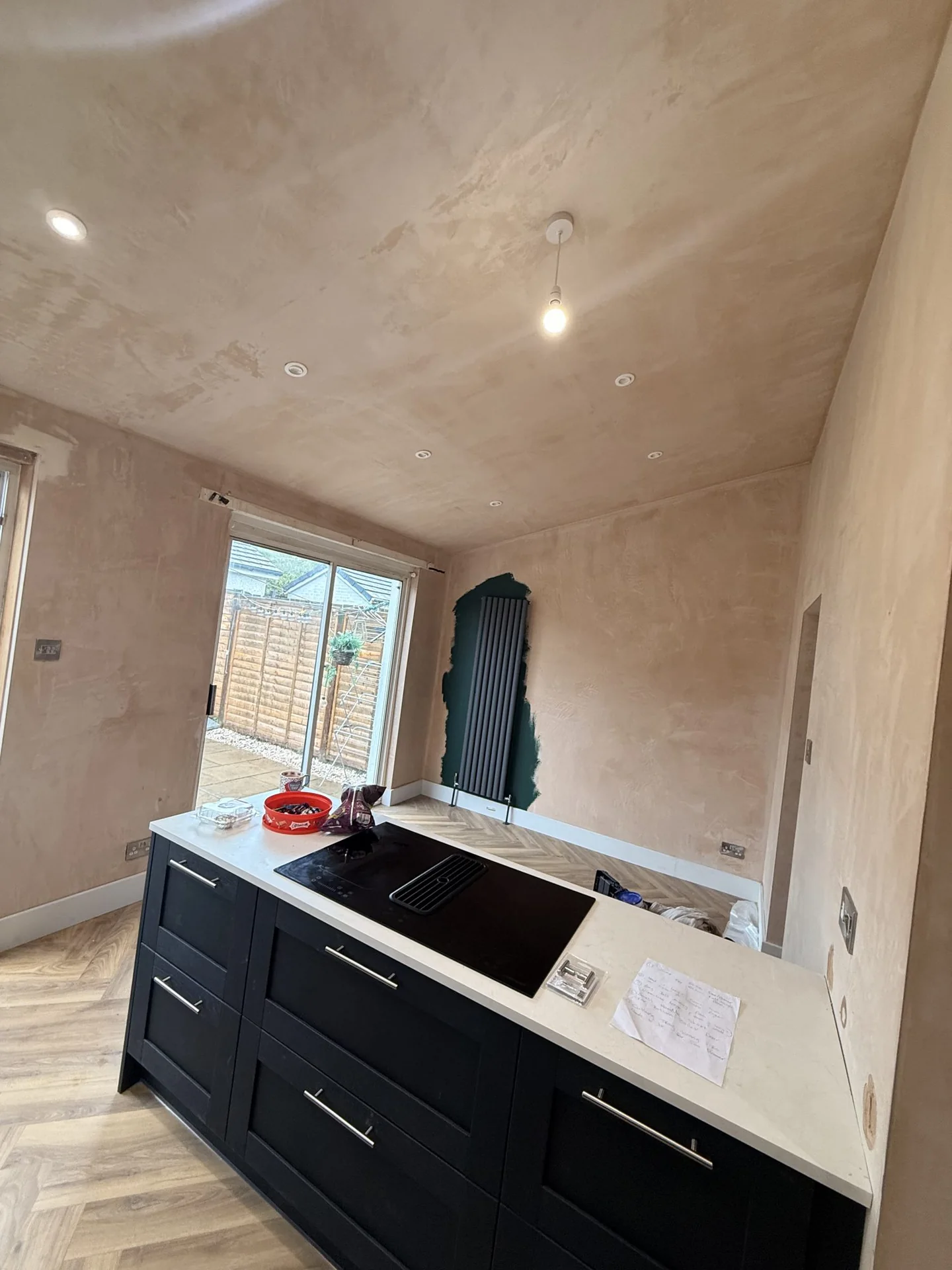
What skimming is and when walls need it
Skimming means trowelling a thin coat of finishing plaster, usually a few millimetres, over an existing wall or ceiling and polishing it smooth. It is not the same as fully re-plastering back to brick; the existing surface stays and the skim gives it a new face.
Typical signs a wall needs it: a network of fine cracks, years of filler patches that show through paint, chipped corners, bumps left by old fixings, or a surface that has been torn up when wallpaper came off. A skim also unifies walls where different repairs have left different textures.
Skimming over woodchip or damaged plaster
Woodchip paper is common in older Glasgow homes and is notoriously stubborn. Once it has been stripped, the plaster beneath is often scarred or loose in places. Loose sections are cut back and made good, and the whole wall is then skimmed so it reads as one flat surface. You can read more on the woodchip removal page.
Ceilings and cornicing
Ceilings take the same treatment but need more care because you are working overhead. Cracks along plasterboard joints, stains from an old leak that has since been fixed, or dated textured finishes can be skimmed to a clean, flat surface. In tenement rooms the skim is stopped neatly at the cornice line and finished by hand, so the original plasterwork is protected rather than buried.
Drying time, then decorating
Fresh plaster goes from dark pink to an even pale colour as it dries. How long that takes depends on thickness, temperature and airflow. Painting too early traps moisture and leads to peeling, so the timetable allows for it. When the wall is ready, it is sealed with a diluted mist coat and then given its finish coats.
Because Louise also paints and hangs paper, she returns to finish the room herself. There is no gap waiting for a separate decorator, and no arguments about whose work caused a problem.
Getting the room ready
Before the day, clear shelves, pictures, curtains and anything fragile, and move what furniture you can into another room. It also helps to tell Louise about any wiring or pipe runs you know of in the walls. The rest of the protection, from floor sheets to covered sockets, is handled on arrival.
Get a quote
Send your Glasgow postcode with photos of the walls or ceilings, taken in daylight, and rough room sizes.